


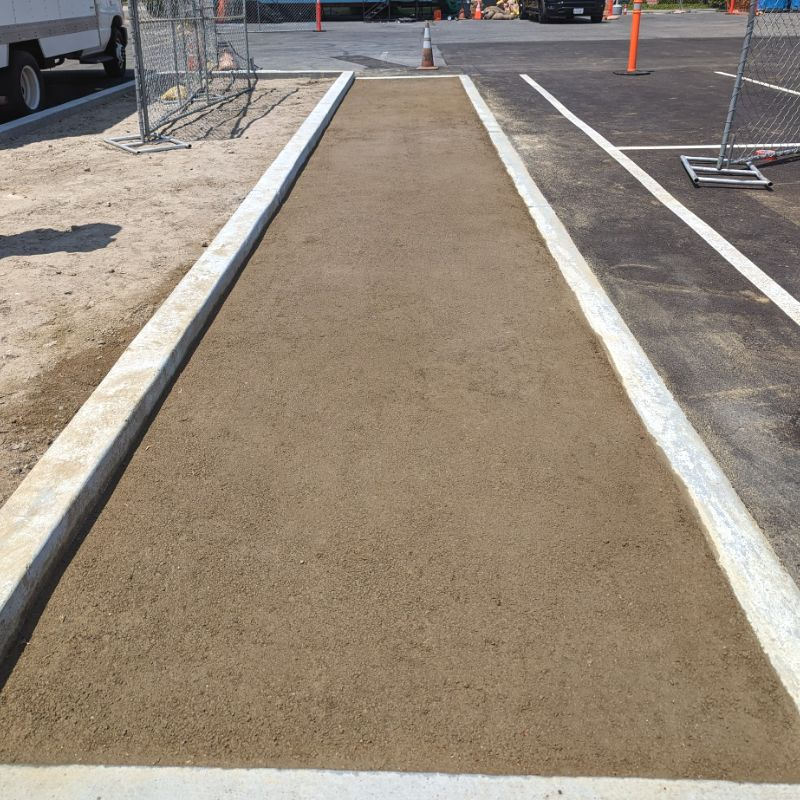
| This month marks the third and final installment in our three-part series highlighting the key components of a GraniteCrete installation. This month, we focus on achieving proper curing after GraniteCrete has been installed. Proper curing is essential to achieving long-term strength and durability and ensuring a beautiful GraniteCrete surface for many years. |
| The curing process is what makes GraniteCrete achieve its strength and longevity, allowing a well-cured installation to remain beautiful for many years, even under heavy use. Slow curing of GraniteCrete is important to control cracking and ensure the surface gains maximum strength evenly throughout the curing process. |
| What Happens During Curing The curing process has both a physical and a chemical component, and each adds to proper curing and strength gain for the final cured product. At a physical level, moisture migrates inside the installed GraniteCrete, while overall moisture begins to dissipate to the air and into the subgrade. Compaction brings particles into close contact so that a continuous but thin skeleton forms at contact points, locking the GraniteCrete into a stiff, interlocked granular composite. Proper moisture level and compaction create the environment for an excellent curing process, but the final strength and longevity are built during curing. As water is consumed by hydration of the particles and some is lost to evaporation, very small internal voids form. These are partly accommodated by the granular structure, so shrinkage cracking is usually less than in full-depth concrete, but microcracking still occurs and is part of the normal physical evolution. The net physical result is a stiff, drainable, bound aggregate system with enough cohesion for pedestrian and light-vehicle traffic when properly compacted. Chemically, only a portion of the GraniteCrete grains hydrate in the first day or two; the rest react slowly as water diffuses in, which is why strength gain continues for weeks. Calcium hydroxide can slowly react with atmospheric CO₂ to form calcium carbonate, which contributes modestly to later-age stiffness and durability. Because of the lower moisture content than is typical for concrete, hydration is moisture-limited: local zones with adequate water hydrate well, while drier microzones hydrate more slowly until they pick up ambient moisture, then gradually contribute to strength. Proper Curing Is About Moisture Achieving full strength and lasting beauty requires maintaining a steady moisture content during the curing process. Overmoisture or premature drying out of the installation will weaken it.Proper moisture management can be achieved by regularly misting the installation during the first few days after installation, or by covering the installation for several days to retain moisture. Be sure to protect the installation from excessive moisture. During the first 48 hours, it is critical to prevent any uncontrolled heavy water exposure – including rain, irrigation systems, or sprinkler runoff – from contacting the surface. Maintaining some moisture content, however, is critical – moisture is essential to the curing process.If rain is forecast during the first 48 hours of the curing period, the surface should be covered with plastic to prevent rain from coming in direct contact with – or puddling on the surface of – the material. If temperatures fall below 50°F, the curing process should be extended by 5 days. Curing Period and Protection Most of the strength gain happens in the first 7–14 days and is effectively complete for pathway use by about 28 days under typical conditions. Under proper conditions, after 7 days GraniteCrete achieves 65-80% of its full strength; after 14 days it reaches 85-90%, and is near 100% after 28 days.Freshly installed GraniteCrete should be protected from traffic and environmental exposure. While light foot traffic is allowed 24 hours after installation, it is best to stay off newly installed areas for at least 72 hours whenever possible. Vehicular traffic should be avoided for at least 14 days after installation to allow the surface to gain strength. What to Expect During Cure Time Minor cracking may occur during the curing process. Over time, aggregate fines will naturally settle into these small cracks and help them blend into the surrounding surface. If additional repair is needed, refer to GraniteCrete’s Maintenance and Repair document.At the end of the curing period, the entire surface should be swept or blown clean to remove any loose surface materials. (A thin veneer of loose aggregate may be present after curing, which is normal.) |
| Proper curing is the final critical step in any GraniteCrete installation. When proper moisture content, compaction, and curing practices are followed together, the result is a durable, long-lasting surface built to perform for years to come. |